1. Let's start with what a Peatland is. A peatland is a type of wetland and is among some of the most important ecosystems on Earth. The name itself refers to the peat soil and the wetland habitat which grows upon its surface. Peat is a water-logged soil formed through the slow biodegrading of dead trees, plants, and other organic compounds that can only partially decompose due to the water clogged consistency of the area.

    Peatlands absorb vast amounts of carbon from our planets atmosphere, storing it below ground. You can find, on average, 20 times more carbon stored in a peatland compared to that which trees and vegetation can hold. Although these unique habitats cover only 3% of the Earth surface, they can store more carbon than all other vegetation types in the world combined. It's vital that we conserve and restore peatlands as when they are destroyed, the carbon within them is released into the atmosphere as carbon dioxide.

    A calculation that shows up to 36% of the worlds tropical peatlands can be found in Indonesia. A lot are increasingly being destroyed to make way for agricultural farming, including the plantation of palm oil and acacia crops. From 2000 to 2015, Indonesia lost on average 498,000 hectares of forest each year! - a rough equivalent to 996000 football fields or just over a quarter of Wales!

    • Text content image
  2. The Project

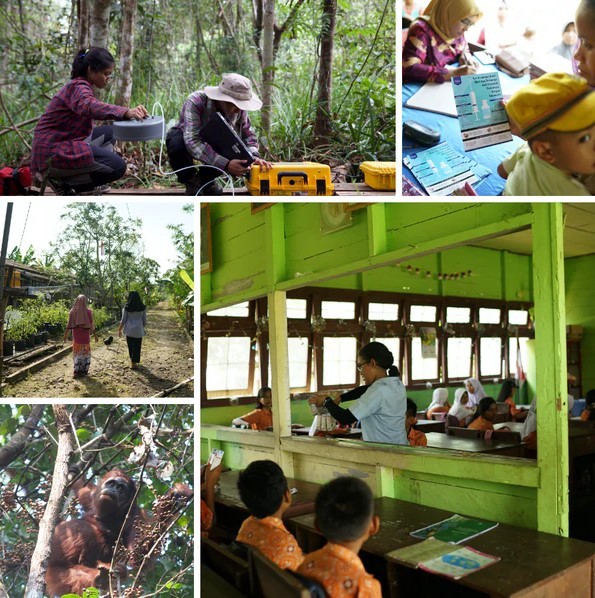
    This project is located within Katingan and Kotawaringin Timur districts in the Central Kalimantan Province of Indonesian Borneo; this project sets out to protect and restore 149,800 hectares of peatland ecosystem. Protection of the existing peatland forest is carried out through satellite monitoring and fire management. The forests are monitored through high-resolution satellite imagery, which allows for the quick detection of small scale changes, for example, fires or logging activities. This gives the field staff the ability to intervene quickly before people or fires can cause significant damage.

    Dried peat is highly flammable, so when large areas of above-ground vegetation are cleared, and the soil is drained, it can cause significant issues. The team has a highly sophisticated and advanced process including drones, satellite monitoring, over 500 professionally trained community firefighters, and planting sections of fire-resistant tree species to prevent fires from damaging the project area. This is only one half of what the team on the ground do, though, for the project. As well as preventing fires and illegal logging activities from taking place they also work to restore the previously damaged areas of the peatland forests. Their efforts include the backfilling of canals to manage water around the site more effectively and the construction of deep wells.

    Core Goals

    1. Protect the carbon stored within the peatlands to prevent its release back into the atmosphere, which would severely negatively affect climate change.
    2. Protect the region's rich biodiversity, which contains 44 critically endangered vulnerable plant and animal species (including 5-10% of the world's remaining Bornean orangutan population).
    3. Improve the wellbeing and sustainable economic prospects of the 43,000 local people through initiatives such as:
      1. Supporting local female-led businesses with micro-finance loans
      2. Youth job training and internships
      3. The provision of health education and wellbeing support to help the most vulnerable community members.

    Verification

    This project is verified by the Verified Carbon Standard and Climate, Community and Biodiversity Standard. You can view it on the Verra Registry.

    • Text content image
    • Text content image
  1. UN's Sustainable Development Goals:

    Katingan Peatland Restoration and Conservation

    As a Printlogik customer, you automatically donate towards our Print A Tree Project through any purchase you make with us. Your money supports projects in line with the United Nations Sustainable Development Goals. Here are the goals recognised by the Katingan Peatland Restoration and Conservation project:

  1. UN SDG Goal 1

    1. No Poverty
    End poverty in all its forms everywhere.

    UN SDG Goal 3

    3. Good Health And Well-Being
    Ensure healthy lives and promote well-being for all at all ages.

    UN SDG Goal 4

    4. Quality Education
    Ensure inclusive and equitable quality education and promote lifelong learning opportunities for all.

    UN SDG Goal 6

    6. Clean Water and Sanitation
    Ensure availability and sustainable management of water and sanitation for all.

    UN SDG Goal 9

    9. Industry, Innovation and Infrastructure
    Build resilient infrastructure, promote inclusive and sustainable industrialization and foster innovation.

    UN SDG Goal 10

    10. Reduced Inequalities
    Reduce inequality within and among countries.

    UN SDG Goal 13

    13. Climate Action
    Take urgent action to combat climate change and its impacts.

    UN SDG Goal 15

    15. Life on Land
    Protect, restore and promote sustainable use of terrestrial ecosystems, sustainably manage forests, combat desertification, and halt and reverse land degradation and halt biodiversity loss.


  2. Brad

    About the Author

    Hi, I'm Brad, Director of Printlogik. With years of expertise, I'm dedicated to enhancing business connections and brand awareness. Dive into our blog for my insights.